A skid steer can spend much of the day moving between stockpiles, work areas, and material piles, often switching between careful attachment work and faster travel. Grading, positioning an attachment, or working close to a structure calls for slow, controlled movement, while crossing the jobsite between tasks benefits from greater travel speed. Treating both situations the same can add unnecessary travel time or make precise work harder to control.
That difference is where a two-speed drive system becomes useful. Low range provides the controlled movement needed for attachment work, grading, and positioning, while high range allows the machine to cover longer distances more quickly. Switching between these ranges lets the operator match travel behavior to the task instead of relying on one fixed speed range throughout the day.
Across a busy construction site, the benefit comes from using each range at the right time. Slow operation supports accuracy when the attachment is doing the work, while higher travel speed helps reduce time spent moving between work zones. Understanding how the system works also helps operators use the skid steer more efficiently without giving up the control required for demanding tasks.
How Two Speed Drive Works
A two-speed drive system gives the machine two distinct travel ranges: a lower range built for controlled operation and a higher range built for faster movement. The two exist because a skid steer does two fundamentally different kinds of work, and each rewards a different balance of control and speed. Rather than compromise on one setting, the operator selects the range that fits the moment.
The low range is where the machine works. Pushing, digging, grading, and running attachments all call for the greater control and tractive effort that a slower travel range delivers. The high range is where the machine travels, letting it cover open ground between work areas far more quickly. Switching between them takes a moment, and knowing when to switch is what separates efficient operation from wasted time.
Key takeaway: Two-speed drive provides a low range for controlled work and a high range for faster travel, letting the operator match the machine’s movement to the task.
When Low Speed Is Useful
Low speed is about control, and control matters most when precision or power is on the line. Working close to obstacles, a wall, or other equipment, the slower range gives you the fine command to position the machine exactly where it needs to be without overshooting. The same applies when handling demanding loads, where steady, measured movement keeps everything under control.
Low range also delivers the tractive effort that heavy work demands. Digging into packed ground, pushing a full blade, grading a level surface, or running an attachment that needs steady input all benefit more from available pulling power and control than from top speed. In these tasks, going slow isn’t a limitation; it’s the setting that lets the machine do the work properly.
Key takeaway: Use the low range for digging, pushing, grading, attachment work, and any situation where control and tractive effort matter more than travel speed.
Where High Speed Saves Time
High speed earns its value the moment the machine stops working and starts traveling. On a larger jobsite, the distance between a stockpile, a loading area, a work zone, and a staging spot adds up fast, and crossing that ground in the low range wastes real time on every cycle. The high range shrinks those travel segments and keeps the workday moving.
The payoff is simple: shorter travel cycles mean the attachment spends more of its time actually producing instead of crawling across the site. Over a full shift of repeated trips, that difference compounds into meaningful gains. Whenever the path ahead is clear and the task is transport rather than work, the high range is usually the right call.
Key takeaway: The high range reduces travel time between stockpiles, work zones, loading areas, and staging spots, keeping the attachment productive instead of crossing the site slowly.
Travel Speed and Ground Conditions
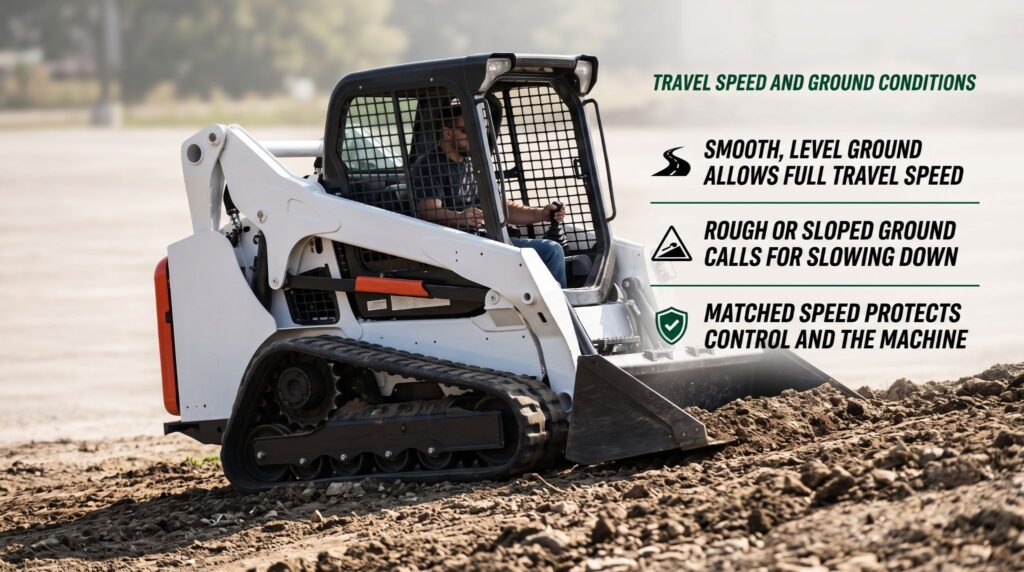
Rated speed and real speed aren’t the same thing, because the conditions underfoot always have the final say. Actual travel performance depends on the surface, the slope, the load being carried, tire condition, and the overall operating environment. A smooth, level, dry surface may let the machine travel at its full range, while rough, soft, or sloped ground calls for backing off.
Matching your speed to the conditions does more than keep you moving; it protects both control and the machine itself. Pushing high speed across rough ground jars the equipment, reduces your command of the machine, and invites unnecessary wear and impact. Slowing down for uneven terrain, slopes, or a heavy load keeps the skid steer stable and controlled. The goal is the right speed for the ground you’re on, not the highest speed the system offers.
Key takeaway: Surface, slope, load, and tire condition all shape real travel performance, so match your speed to the conditions to protect control and reduce impact on the machine.
Transport Efficiency Between Jobs
Moving a skid steer breaks down into two very different situations, and it’s important not to confuse them. On-site relocation, shifting the machine between work areas within a project, is where faster self-propelled travel shines. The high range lets the machine reposition itself efficiently under its own power, saving time whenever the work moves from one part of the site to another.
Getting to an entirely different jobsite is another matter. Road transportation normally requires a suitable trailer or another approved transport method rather than driving the machine across public roads. Before any such move, weigh the machine’s dimensions, operating weight, and attachment configuration, since all three affect how it must be loaded and hauled. Planning transport around these factors keeps relocation between jobs safe and compliant.
Key takeaway: High-range self-propelled travel makes on-site relocation efficient, but moving between jobsites normally requires a suitable trailer, with dimensions, weight, and attachment configuration considered first.
Balancing Speed and Productivity
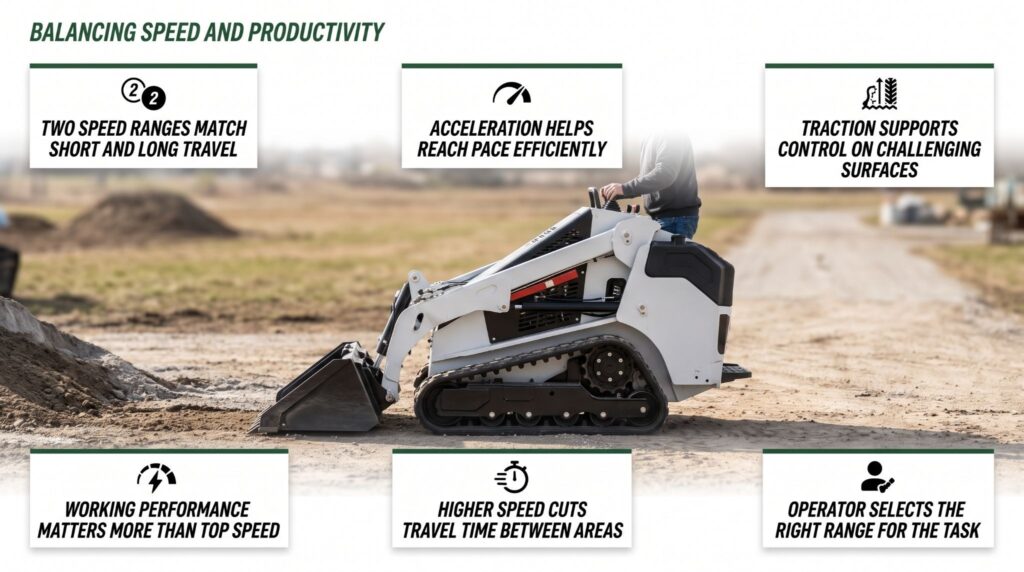
Top travel speed can attract attention, but overall skid steer productivity depends on much more than maximum speed. Acceleration, traction, hydraulic performance, attachment demands, operator control, and the distances covered on the jobsite all influence how efficiently the machine completes each cycle. A machine that moves quickly but struggles with traction or working power may not save meaningful time when the actual task begins.
A two-speed travel system allows the operator to match the machine’s movement to the job. Lower speed is useful when control, pushing force, and precise positioning matter, while higher speed can help reduce travel time when moving between work areas. Using the appropriate range for each situation helps balance travel efficiency with working performance.
- Travel Speed: Provides different speed ranges to match short working movements and longer site travel.
- Acceleration: Helps the machine reach the appropriate travel pace efficiently when moving between tasks.
- Traction: Supports controlled movement and pushing performance when working on challenging surfaces.
- Working Performance: Keeps the focus on the power and control needed for the actual task, not just travel speed.
- Jobsite Movement: Helps reduce unnecessary travel time when operators need to move between different work areas.
- Operator Control: Allows the operator to select the appropriate travel range based on the terrain, task, and required level of control.
Key takeaway: Travel speed is one factor among many, so use the right range for each task to balance movement efficiency with the traction, hydraulics, and control the work actually needs.
Conclusion
A two-speed drive system allows a skid steer to switch between a lower range for controlled work and a higher range for faster travel between work areas. Low range provides greater control and supports tractive effort during digging, pushing, grading, loading, and demanding attachment operation, while high range can reduce travel time when relocating between stockpiles, staging areas, and separate sections of a jobsite. Appropriate range selection should account for surface condition, slope, payload, tire or track condition, attachment configuration, and required maneuverability because higher travel speed does not replace the need for adequate traction or hydraulic performance. High-range travel is generally suited to on-site movement, while transportation between separate jobsites normally requires a trailer that meets the machine’s weight and configuration requirements. Overall productivity therefore depends on more than maximum travel speed, with drive range, traction, hydraulic capacity, load, distance, and operating conditions all contributing to efficient machine use.
Frequently Asked Questions
What is a two-speed drive on a skid steer?
A two-speed drive provides two travel ranges: a slower range for working and a faster range for moving between work areas. Low speed supports controlled movement and tractive effort for digging, grading, and attachment work, while high speed reduces travel time across larger jobsites. This lets the operator match travel speed to the task instead of relying on one fixed range.
When should a skid steer use low speed?
Use low speed for digging, pushing, grading, attachment work, and tasks requiring precise control or strong tractive effort. It is especially useful near obstacles or when working with heavy loads and demanding attachments. Slower movement provides better control when power and precision matter more than travel speed.
Does higher travel speed improve skid steer productivity?
Higher travel speed can reduce time spent moving between work areas, which can improve productivity on larger sites. However, overall output also depends on acceleration, traction, hydraulics, attachment performance, terrain, load, and cycle time. Using the appropriate speed range for each part of the job is more important than simply traveling as fast as possible.
Can a skid steer travel on public roads?
Road use depends on local regulations, machine configuration, and applicable requirements. Many skid steers are transported between jobsites on suitable trailers rather than driven on public roads. Before transport, consider the machine’s dimensions, operating weight, and attachment configuration, then use the appropriate trailer and securement method while following local requirements.