
Moving a loaded pallet from a warehouse storage aisle to a distant loading zone can seem like a routine forklift trip. Along the route, however, the operator may encounter intersections, narrow aisles, ramps, pedestrians, and parked equipment, each requiring a different level of attention. The machine may be capable of covering the distance quickly, but safe transport depends on controlling speed, keeping the load positioned correctly, and reading the route ahead. A steady trip keeps the load stable and visibility manageable, while rushed movement or poor load positioning can quickly create a safety problem.
Travel speed is only one part of effective material transport. Load height, load position, surface conditions, visibility, traffic, and route layout all influence how the forklift should be operated. Matching speed to these conditions helps maintain control without treating the machine’s maximum travel capability as the target.
Across a typical warehouse or jobsite, good transport comes from making small adjustments throughout the trip. Slowing near intersections, keeping the load low and stable, checking blind areas, and allowing enough space around pedestrians and equipment all support smoother movement. Understanding these factors helps operators move materials efficiently while keeping each trip controlled from pickup to delivery.
How Travel Speed Affects Control
The right forklift travel speed is set by the conditions around you, not by what the machine can do at full tilt. Just because a lift can move quickly doesn’t mean the aisle, the traffic, or the surface will allow it safely. The environment sets the limit, and the operator’s job is to read it and match the pace to it.
Certain conditions call for noticeably more control. Narrow aisles, pedestrian areas, intersections, ramps, and congested zones all reduce your margin for error, and each is a cue to slow down and stay deliberate. Speed that feels reasonable on an open, empty floor becomes reckless the moment people or tight clearances enter the picture.
How you change speed matters as much as the speed itself. Smooth acceleration and gradual braking keep the load settled on the forks, while sharp starts and hard stops can shift or destabilize it. Deliberate inputs protect both the load and your control of the machine.
Key takeaway: Match travel speed to the surrounding conditions rather than the machine’s maximum, slowing for aisles, pedestrians, intersections, and ramps, and using smooth acceleration and braking to keep the load stable.
Keeping the Load Properly Positioned
How a load sits on the forks decides how the forklift handles from the first foot of travel. A pallet should rest securely against the fork carriage and stay as close to the mast as the load practically allows. Pulled in tight this way, the weight sits where the machine expects it, which keeps handling predictable throughout the trip.
That position isn’t just about tidiness. Keeping the load close to the mast maintains the intended load center and reduces unnecessary forward leverage, the same leverage that can work to tip a forklift forward when weight sits too far out on the forks. A load carried close is a load the machine can manage; one carried out on the fork tips fights the balance the forklift depends on.
Stability before movement is the final check. The load should sit squarely and securely on the forks before the forklift begins to travel, not shift or settle once you’re already rolling. A few seconds confirming the load is seated and stable saves you from discovering a problem mid-route.
Key takeaway: Position the pallet securely against the fork carriage and close to the mast to maintain the load center and reduce forward leverage, and confirm the load is stable before traveling.
Load Height During Movement
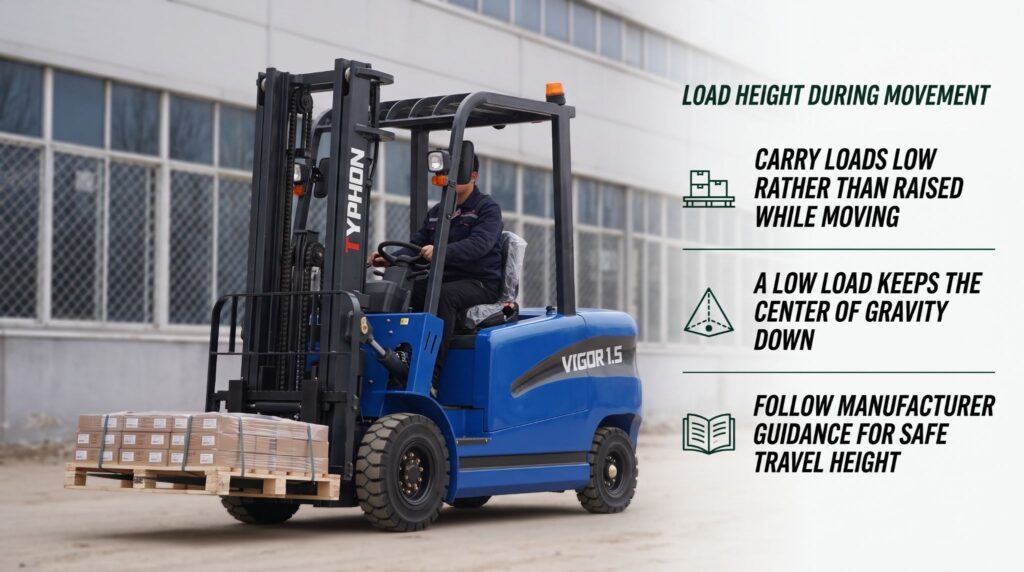
Where you carry the load vertically matters just as much as how you position it front to back. Loads should generally travel at a low, stable height rather than raised high while the forklift is moving. A raised load lifts the machine’s combined center of gravity and makes it far less stable, especially through turns.
Carrying low pays off in two ways at once. It keeps the center of gravity down for better stability, and it clears your line of sight so you can see more of the path ahead. A load held high does the opposite, raising the tipping risk while blocking the very view you need to travel safely.
None of this replaces the manufacturer’s guidance. Follow the forklift manufacturer’s operating instructions and any applicable workplace requirements for travel and load handling, since these define the safe travel height and practices for your specific machine and site.
Key takeaway: Carry loads at a low, stable travel height to improve stability and forward visibility, and follow the manufacturer’s operating instructions and workplace requirements.
Ground Conditions on the Route
The surface under the forklift plays directly into whether a load stays put. Uneven floors, potholes, ramps, wet surfaces, and scattered debris can all disturb stability and control, and their effect grows with the weight and height of the load you’re carrying. A surface that poses no trouble can become a real hazard with a loaded machine.
Speed and surface work together here, and not in your favor when both go wrong. A sudden change in floor level, taken too quickly, can jolt a load enough to shift it, while wet or debris-strewn patches can compromise traction and braking. The faster you hit a rough spot, the less the load and the machine forgives it.
The fix is to know the route before you commit to it. Inspect the planned path, note where the surface changes, and adjust your speed to those conditions as you travel. Reading the ground ahead and easing off for the rough stretches keeps site transport controlled from start to finish.
Key takeaway: Uneven floors, potholes, ramps, wet surfaces, and debris disturb stability, especially under load, so inspect the route and adjust speed to the conditions.
Visibility Around the Forklift
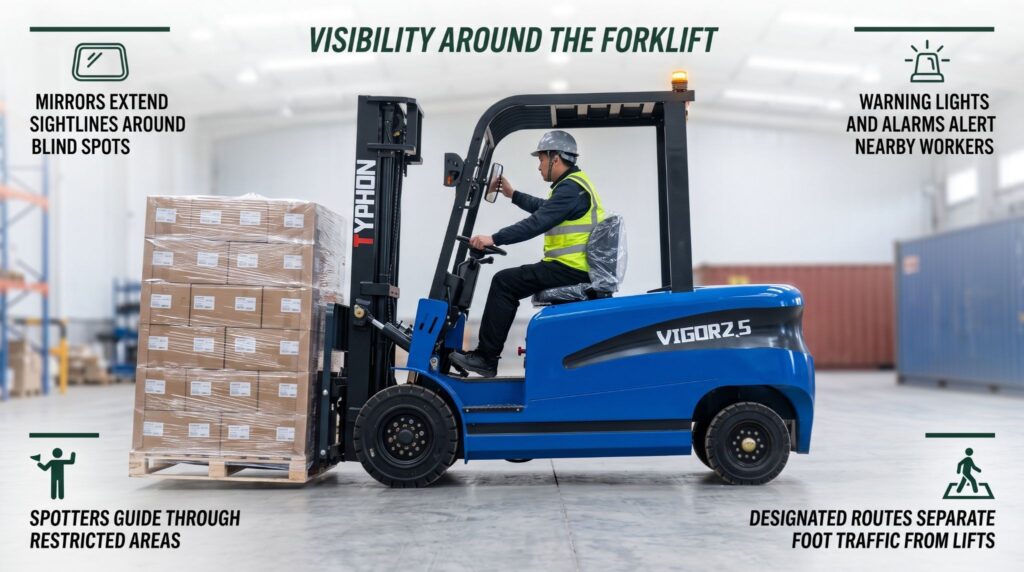
A clear view of the path is essential, and the load itself is often what takes it away. A large or tall pallet can block the operator’s forward view, leaving a blind spot exactly where you need to see. Traveling without a clear sightline puts everything in that blind zone at risk.
When a load restricts the forward view, the operator may need to travel in the direction that keeps the travel path clearly visible, following the site’s established procedures for doing so. The point is simple: never travel toward ground you can’t see. Keeping the path in view takes priority over the convenience of any single direction.
Several aids support safe movement where a load or the layout limits your view:
- Mirrors to extend sightlines around blind spots and corners.
- Warning systems such as lights or alarms to alert others nearby.
- Spotters to guide the operator through especially restricted areas.
- Designated pedestrian routes that keep foot traffic separated from lift paths.
Key takeaway: A load can block the operator’s forward view, so travel in the direction that keeps the path clearly visible per site procedures, and use mirrors, warning systems, spotters, and pedestrian routes where applicable.
Transport Through Busy Areas
Warehouses and construction sites are shared, crowded spaces. Vehicles, pedestrians, storage racks, equipment, and other obstacles all occupy the same floor the forklift has to cross, and every one of them is something to account for while carrying a load. Busy areas demand more attention, not more speed.
Moving through that environment well means reading it constantly. Account for traffic patterns, intersections, turning areas, and the clearance you need on either side and overhead as you transport the load. Anticipating where other traffic will be, and where the tight spots are, lets you move through without last-minute stops or close calls.
Planning the route ahead of time ties it all together. A thought-out travel path reduces unnecessary stops, avoids the worst congestion and clearance pinch points, and keeps material movement organized across the site. The best trip is often the one you’ve mapped before you ever pick up the load.
Key takeaway: Busy sites mix vehicles, pedestrians, racks, and equipment, so account for traffic patterns, intersections, turning areas, and clearance, and use planned routes to keep material movement organized.
Conclusion
Forklift travel performance depends on more than maximum speed because load position, lift height, visibility, surface conditions, traffic, and route layout all affect machine control and stability during transport. Loads should be secured evenly on the forks and positioned as close to the carriage or mast as the load and manufacturer requirements permit, while carrying the load as low as practical helps maintain visibility and stability. Travel speed should be adjusted to the operating environment, with slower movement through aisles, intersections, ramps, pedestrian areas, uneven floors, wet surfaces, and other restricted conditions. Smooth acceleration, braking, and turning also help maintain control and reduce load movement. The travel route should be checked for potholes, debris, surface changes, overhead restrictions, narrow clearances, and turning areas, while mirrors, spotters, and designated pedestrian routes can help manage visibility limitations. Planning routes around traffic flow and available maneuvering space allows the operator to maintain appropriate clearance throughout each transport cycle. Evaluating load position, lift height, visibility, surface condition, traffic, route layout, and travel speed together supports controlled and efficient forklift movement across daily warehouse, distribution, and industrial operations.
Frequently Asked Questions
How fast should a forklift travel?
There is no single safe speed for every situation. Follow the manufacturer’s limits and site rules, then adjust speed for pedestrians, visibility, surface conditions, load characteristics, and traffic. Open, clear floors may allow a moderate pace, while narrow aisles, ramps, intersections, or busy areas require slower travel. The goal is to maintain full control rather than simply use the forklift’s maximum speed.
Why should loads stay close to the mast?
Keeping the load close to the mast helps maintain the intended load center and reduces forward leverage. When a load extends toward the fork tips, its center of gravity moves farther forward, increasing tipping forces and potentially reducing the forklift’s effective capacity. Pulling the load back against the carriage keeps its weight closer to the designed load center and improves stability during travel.
How high should a forklift carry a load while traveling?
Loads should be carried as low as practical while maintaining ground clearance and following the manufacturer’s instructions. A raised load increases the combined center of gravity, reducing stability and increasing tipping risk, especially during turns. Keeping the load low also improves forward visibility. Raise it only when positioning or retrieving the load.
What affects forklift transport efficiency?
Transport efficiency depends on travel distance, speed, load position, route conditions, visibility, and traffic. Uneven floors, ramps, wet surfaces, pedestrians, and blocked views may require slower travel or additional stops. Planning routes to reduce congestion, unnecessary stops, and tight clearance areas keeps material moving more efficiently. Effective transport comes from managing the entire route, not simply traveling faster.
