
Road rollers are powerful, deceptively heavy machines that compact asphalt, soil, and aggregate into the dense, stable surfaces every paving project depends on. That same power makes them dangerous when operated carelessly. Tip-overs, rollovers, pedestrian strikes, and vibration-related injuries account for a significant share of compaction equipment incidents on construction and paving jobsites every year.
The good news is that nearly all of these incidents are preventable. Strong road roller safety comes down to consistent habits, clear communication, and a disciplined respect for the machine’s limits.
This guide is written for construction business owners, site supervisors, safety managers, and the operators who run these machines shift after shift. Below, you will find the most important road roller operator safety rules covering pre-shift inspections, seatbelt use, blind spots, slope operation, vibration safety, trench edges, pedestrian awareness, speed control, jobsite communication, and proper shutdown.
Why Road Roller Safety Deserves Focused Attention
Road rollers behave differently from most other heavy equipment. They are heavy for their size, carry their weight in a way that affects stability on slopes, and produce powerful vibration that introduces hazards no other machine shares.
Operators also work in some of the most congested zones on a jobsite. Paving crews, material trucks, and ground workers all share space with the roller, often within arm’s reach. Add the noise of active compaction and the limited sightlines around the drums, and you have an environment where a single lapse in awareness can cause serious harm.
Treating compaction equipment safety as its own discipline, not an afterthought borrowed from other machines, is the foundation of an incident-free operation.
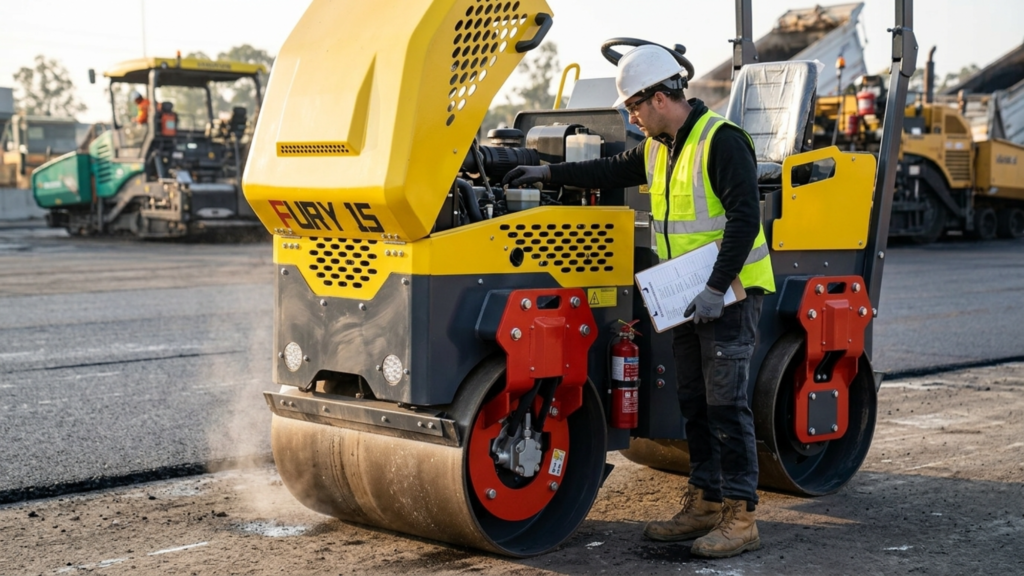
Rule 1: Complete a Documented Pre-Shift Inspection
No operator should take a road roller onto an active jobsite without completing a thorough pre-shift inspection. This is your first and most reliable defense against equipment-related incidents.
What Every Pre-Shift Inspection Should Cover
- Fluids: Engine oil, coolant, hydraulic fluid, and fuel levels are correct with no visible leaks underneath the machine
- Drum and scraper bars: Drum surface is free of damage; scraper bars contact the drum correctly
- Water spray system: Tank is filled and every nozzle produces an even spray across the drum
- Brakes: Service and parking brakes hold the machine firmly
- Controls: Steering, throttle, and vibration controls respond smoothly without sticking
- Safety devices: Horn, backup alarm, lights, and seatbelt all function correctly
- Tires (pneumatic models): Correct pressure with no deep cuts or embedded debris
- ROPS and structure: Rollover protective structure is intact with no cracks or missing hardware
Any defect must be reported and tagged out immediately. A machine with a known fault stays parked until maintenance resolves the issue, not until the end of the shift.
Quick summary: A five-minute inspection catches problems before they become incidents on a live paving train.
Rule 2: Always Wear the Seatbelt
The seatbelt is the single most important piece of safety equipment on a road roller, and it works hand in hand with the ROPS. In a rollover, the structure protects the operator only if the seatbelt keeps them inside the operator station.
The most dangerous instinct during a tip-over is to jump clear. Operators who jump are frequently crushed by the very machine they tried to escape. A buckled operator, by contrast, stays within the protective zone the ROPS is engineered to maintain.
Make seatbelt use non-negotiable. Supervisors should reinforce it daily and treat an unbuckled operator the same way they would treat any other serious safety violation. The rule is simple: if the machine is running, the seatbelt is on.
Rule 3: Know and Respect Your Blind Spots
Road rollers offer limited visibility, especially directly behind the machine and around the drums. The operator’s view is further restricted by the drum frame, the articulation point, and the noise that masks approaching workers.
Practical Steps to Manage Blind Spots
- Walk the work area before starting to note where ground workers will be positioned
- Adjust mirrors at the start of every shift for the clearest possible view
- Use the backup alarm and horn deliberately at every direction change
- Make eye contact with nearby workers before moving, rather than assuming they see you
- Slow down and stop when you lose sight of a ground worker who was recently nearby
Many modern rollers offer backup cameras and proximity-detection systems. Where available, these tools meaningfully reduce the risk of a blind-spot strike but they support operator awareness rather than replace it.
Rule 4: Operate Safely on Slopes and Grades
Slope operation is one of the highest-risk activities for a road roller. The machine’s high center of gravity and heavy drums make it prone to sliding and rollover when handled incorrectly on a grade.
Slope Safety Best Practices
- Travel straight up and down slopes whenever possible; never drive across the face of a steep grade
- Keep the heavy end uphill to maintain stability and traction
- Avoid turning on a slope; if you must change direction, do it on level ground
- Watch for soft or unstable edges that can give way under the drum’s weight
- Reduce speed on every incline and decline to maintain control
Know the machine’s rated gradeability before you start. If a slope exceeds the manufacturer’s specification, it is not a judgment call; it is off-limits. When conditions are wet or the surface is loose, treat even moderate slopes with added caution.
Quick summary: Drive straight up and down, keep the load uphill, and never turn on a grade.
Rule 5: Understand and Manage Vibration Hazards
The vibratory system is what makes a road roller effective, but it introduces hazards unique to compaction equipment. Used incorrectly, vibration damages surfaces, harms the operator, and creates instability.
Vibration Safety Guidelines
- Never engage vibration while stationary for more than a moment; it can damage the surface beneath the drum and create depressions
- Turn off vibration on hard, unyielding surfaces like bridge decks or fully compacted material, where it can damage both the machine and the structure
- Disengage vibration before stopping or reversing to protect surface quality
- Limit continuous exposure to whole-body vibration, which contributes to operator fatigue and long-term health effects
Whole-body vibration is a recognized occupational hazard. Rotate operators on long compaction shifts, ensure seats are properly maintained and adjusted, and follow the manufacturer’s guidance on safe vibration use. A comfortable, well-supported operator stays alert and makes fewer mistakes.
Rule 6: Stay Clear of Trenches, Edges, and Drop-Offs
Working near open trenches, embankment edges, and pavement drop-offs is a leading cause of road roller rollovers. The weight of the machine can collapse an unstable edge without warning, sending the roller over the side.
How to Work Safely Near Edges
- Maintain a safe standoff distance from any trench, excavation, or unsupported edge
- Treat the edge of freshly placed material as unstable until you confirm otherwise
- Watch for undercut or saturated soil that may not support the drum’s weight
- Use spotters and physical barriers to mark no-go zones along edges
- Compact parallel to the edge from a safe distance rather than driving along the very lip
When a project requires compaction close to an edge, plan the approach with your site supervisor before the work begins. A clear plan and a designated spotter remove the guesswork that leads to edge failures.
Rule 7: Maintain Constant Pedestrian Awareness
Paving crews work in close proximity to the roller throughout the operation. Raker operators, screed hands, and inspectors are often just feet from a moving machine, and the noise of active compaction makes it hard for them to hear an approaching roller.
Protecting Ground Workers
- Establish clear right-of-way rules: pedestrians always have priority
- Require high-visibility clothing for every worker in the compaction zone
- Use a spotter in congested areas where the operator’s view is limited
- Sound the horn before starting, before reversing, and at every direction change
- Never assume a ground worker knows where the roller is confirm it
Speed and predictability protect pedestrians more than anything else. An operator who moves slowly, signals clearly, and follows consistent patterns gives the crew the time and information they need to stay safe.
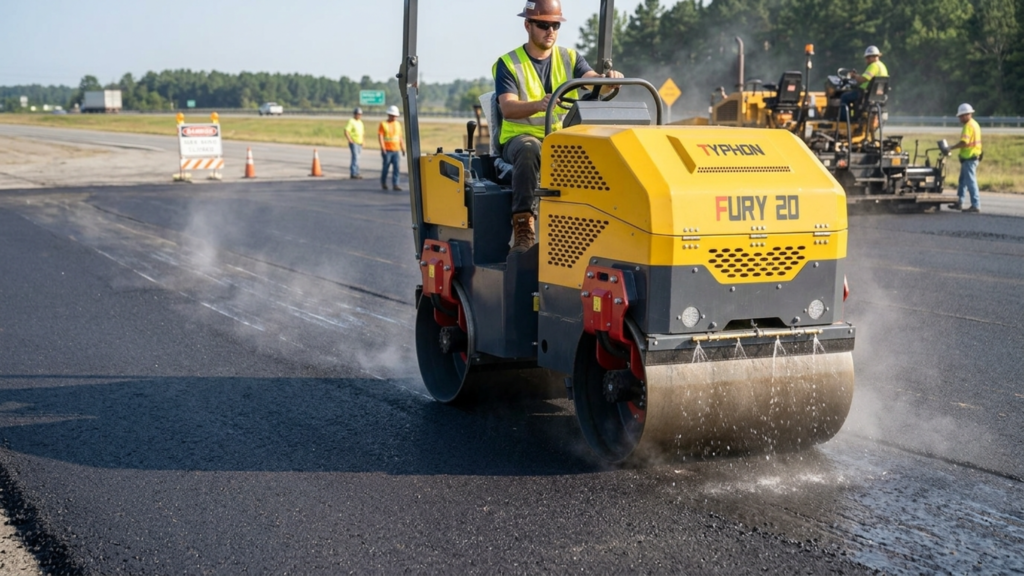
Rule 8: Control Your Speed at All Times
Speed control is fundamental to road roller operator safety. Excessive speed compromises stability, reduces compaction quality, and shrinks the operator’s window to react to a hazard.
Smart Speed Management
- Match travel speed to the material, surface, and compaction specifications
- Slow down significantly near pedestrians, edges, and on any slope
- Avoid sudden starts, stops, and direction changes that can shift the machine’s balance
- Reduce speed in congested or low-visibility areas without exception
Faster passes do not produce better compaction. Proper density comes from the correct number of passes at the right speed and amplitude, not from rushing. A measured pace protects the crew, the surface, and the machine all at once.
Quick summary: Slower, consistent passes deliver better compaction and a safer jobsite than rushing ever will.
Rule 9: Communicate Clearly on Active Jobsites
A paving operation is a coordinated effort involving the roller, the paver, material trucks, and the ground crew. Clear communication keeps every moving part working together safely.
Building Reliable Jobsite Communication
- Agree on standard hand signals that every crew member understands
- Use two-way radios where noise makes voice and hand signals unreliable
- Hold a brief toolbox talk before each shift to review the plan and known hazards
- Confirm the location of every ground worker before beginning a pass
- Establish a clear stop signal that anyone on the crew can use to halt the machine instantly
Communication breaks down most often during shift changes and when new workers join the crew. Brief every new person on the day’s plan, the signals in use, and the right-of-way rules before they step into the work zone.
Rule 10: Follow Proper Shutdown and Parking Procedures
How an operator ends a shift matters as much as how they begin it. Improper shutdown can leave the machine in a dangerous state for the next operator or for anyone working nearby.
Safe Shutdown Checklist
- Park on level ground whenever possible, away from traffic and edges
- Disengage the vibration system before shutting down
- Lower any attachments fully to the ground
- Set the parking brake firmly
- Turn off the engine and remove the key to prevent unauthorized use
- Chock the drums if the machine must be parked on any grade
If the roller is parked on a slope because no level ground is available, position it perpendicular to the grade and chock the drums securely. Report any defects noticed during operation before leaving so maintenance can address them before the next shift.
Quick summary: A proper shutdown protects the next operator and keeps the machine ready for safe use.
Building a Road Roller Safety Culture
Individual rules matter, but the safest operations build these habits into their daily routine. That means supervisors model the same standards they expect from operators, near-misses are reported without blame, and safety performance is reviewed with the same seriousness as production targets.
Start with training. Every operator should be trained on the specific machine they run, understand its limits, and know the emergency procedures. Pair new operators with experienced ones, and schedule regular refreshers rather than waiting for an incident to prompt them.
Then reinforce the fundamentals daily: pre-shift inspections, seatbelt use, speed control, and clear communication. When these become automatic, your jobsite becomes measurably safer.
Frequently Asked Questions
What is the most common cause of road roller accidents?
Rollovers are among the most common and most serious incidents, frequently caused by unsafe slope operation, working too close to unstable edges, or operating at excessive speed. Wearing the seatbelt and respecting slope limits prevents the majority of rollover injuries.
Do road roller operators need certification?
Operators should be trained and qualified on the specific equipment they run. Employers are responsible for ensuring operators understand the machine, its hazards, and safe operating procedures before independent operation, in line with applicable safety regulations.
Why should an operator never jump from a tipping road roller?
A buckled operator stays within the protective zone of the ROPS during a rollover. Operators who jump are often crushed by the machine. The correct response is to stay seated, hold on, and remain belted.
When should the vibration system be turned off?
Disengage vibration when the machine is stationary, when reversing or stopping, and when operating on hard, unyielding surfaces like bridge decks or fully compacted material. Continuous unnecessary vibration damages surfaces and increases operator fatigue.
Conclusion
Road roller safety is built on consistent, disciplined habits rather than luck. The ten rules covered here—pre-shift inspections, seatbelt use, blind-spot awareness, safe slope operation, vibration management, edge safety, pedestrian awareness, speed control, clear communication, and proper shutdown—form a complete framework that protects your people and your equipment.
Start by reviewing your current pre-shift inspection process and confirming that every operator buckles up every time. Those two habits carry an outsized share of controllable risk. From there, reinforce the remaining rules through daily toolbox talks and regular refresher training.
A safe jobsite is a productive jobsite. Put these road roller operator safety rules into practice today, and you protect both your crew and your bottom line for every shift that follows.